Project
Sandton giftware marks
A Sandton giftware shop needed to produce crisp, high-contrast marks on small metal items for the local corporate market. We set up MicroMark packs tailored for their cell.
Related cut: jewellery giftware
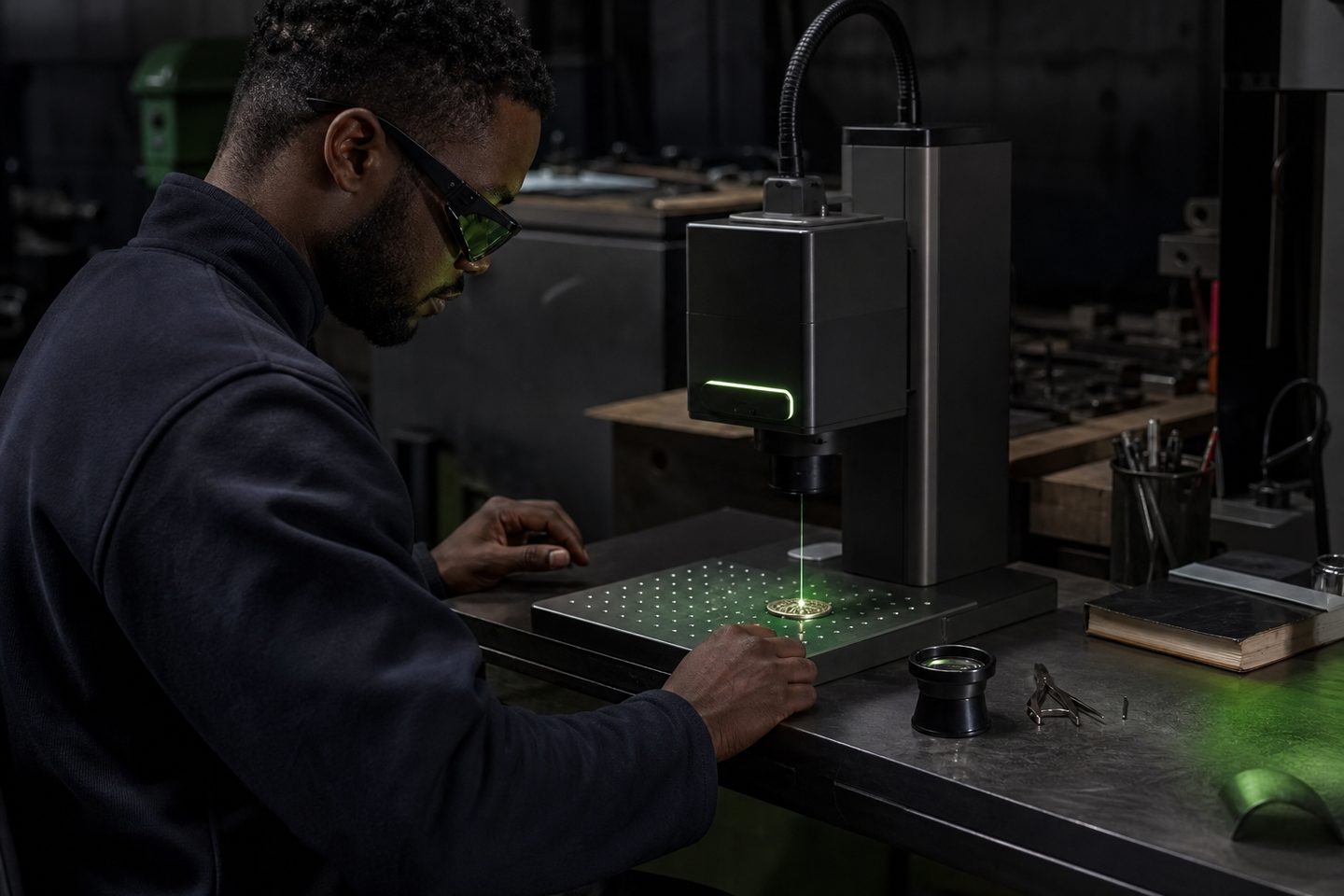
The giftware workshop and their marking challenge
In the heart of Sandton, a busy giftware cell supplies branded items and custom jewellery for Johannesburg’s corporate and events market. Their core work covers stainless keyrings, bottle openers and small anodised aluminium gifts. Orders often come with tight deadlines and a demand for both logo precision and surface contrast.
Before our intervention, the team rotated between hand engraving and basic marking tools that struggled with fine detail on stainless and anodised parts. Inconsistent contrast, especially on small-radius surfaces, meant time lost to rework and rejected pieces. The growth in demand for permanent, tamper-resistant branding on promotional goods highlighted the need for a compact yet precise laser marking setup.
Our MicroMark solution and setup
We recommended a MicroMark Lab cell for its fine micro-marking ability suited to small, reflective items. The shop received a contrast pack: tested parameter sets that cover stainless, anodised aluminium, plated brass and even coated pens. These packs include fixture suggestions and safe marking windows, so the team could focus on throughput rather than trial-and-error with each batch.
Installation at their Sandton premises took one day, with the FibreLaser SA team setting up fume extraction for metals and coatings. Ms Firdous Bassier trained the operators on focus heights, contrast adjustment and safe handling. The cell used the supplied local extraction and was checked for compliance with the OHS Act and SAHPRA registration.
- MicroMark Lab cell set up for fine item marking
- Contrast packs loaded for key local substrates
- Fume extraction and safety checks in place
Production outcomes after several months
Within months, the team reported sharper, more consistent marks across stainless and anodised lines. The ability to swap between contrast packs cut setup time per job, and the repeatable fixture system reduced scrap. Fine Data Matrix codes became viable for corporate tracking and product authentication.
The cell’s operator confidence improved, as the MicroMark’s enclosure and interlocks meant less exposure to open beam hazards. The local Sandton air, with its typical dust and seasonal static, did require regular cleaning of the protective window, but the overall reduction in rework more than offset this routine.
What other workshops can learn from this case
For South African shops handling small metal gifts or branded items, investing in tested parameter packs with a fibre marking cell saves both setup time and material. On-site training and the right extraction reduce exposure to metal fume and legal risk. Frequent cleaning of the protective window keeps marking quality high, especially in dusty or air-conditioned Gauteng shops.
A tailored marking cell like MicroMark Lab, paired with local substrate data, lets even a small team take on demanding jobs with confidence. Always review the site’s licence conditions and train operators on safe loading, especially when jobs vary day to day.
- Use contrast packs for consistent results
- Keep extraction and safety at the centre
- Train staff on substrate-specific settings
- Clean optics often in dusty environments
What our Fibre Laser customers say
Verified Google reviews